
DTLA Without a Car: Your First-Week Metro and Errand Map
Moving to DTLA without a car is realistic, but the easiest version of downtown life is built around repeatable routes rather than one giant map. During your first week, focus on connecting your home to four things: a Metro station, a daily coffee or breakfast option, a grocery or household errand, and one reliable place to meet friends. Once those anchors are clear, Downtown Los Angeles starts to feel smaller and much easier to use.
## Start with your real front door
Open a map and begin at the entrance you will actually use, not the center point of your building. Walk the first five minutes in each direction. Note the nearest Metro entrance, the crossings that feel most natural, where sidewalks narrow, and which streets make the clearest route toward food and errands. A station that looks close on a map may be less useful if the entrance is hidden, the crossing is awkward, or the route forces you into a long detour.
Your first goal is not to memorize every line. It is to learn one dependable path from home to the nearest useful station. In many parts of DTLA, that path can connect you to the Historic Core, Little Tokyo, South Park, Bunker Hill, the Arts District, and destinations beyond downtown without requiring a parking search every time you leave home.
## Build a simple Metro habit
Use Metro for trips that would otherwise create the most friction. Start with one short test ride during daylight. Walk to the station, ride to a familiar downtown stop, exit, and return by a slightly different route. That exercise teaches you where entrances, elevators, escalators, platforms, and street-level connections actually are.
Keep a small mental note of three details: which entrance is easiest from your home, which stop is closest to your regular destination, and where you would wait if someone were meeting you. Downtown transit becomes much less intimidating when you stop treating every station as a puzzle.
For your first week, add one weekday trip and one weekend trip. The weekday ride shows commuter and office patterns. The weekend ride gives you a better sense of how the same stations connect to food, markets, museums, events, and neighborhood walks.
## Choose an errand anchor
A car-free routine needs one dependable errand anchor. Depending on where you live, that may be a market, pharmacy, convenience store, grocery option, or household shop within a comfortable walk or short ride. Pick the place you are most likely to use, then test the route with a small purchase.
The small purchase matters. Carrying a few items home tells you more than looking at a pin on a map. Is the sidewalk comfortable? Is there shade? Would you use a reusable bag, a backpack, or a cart? Does the route still work if you are tired or carrying dinner? These are the details that determine whether an address feels convenient in real life.
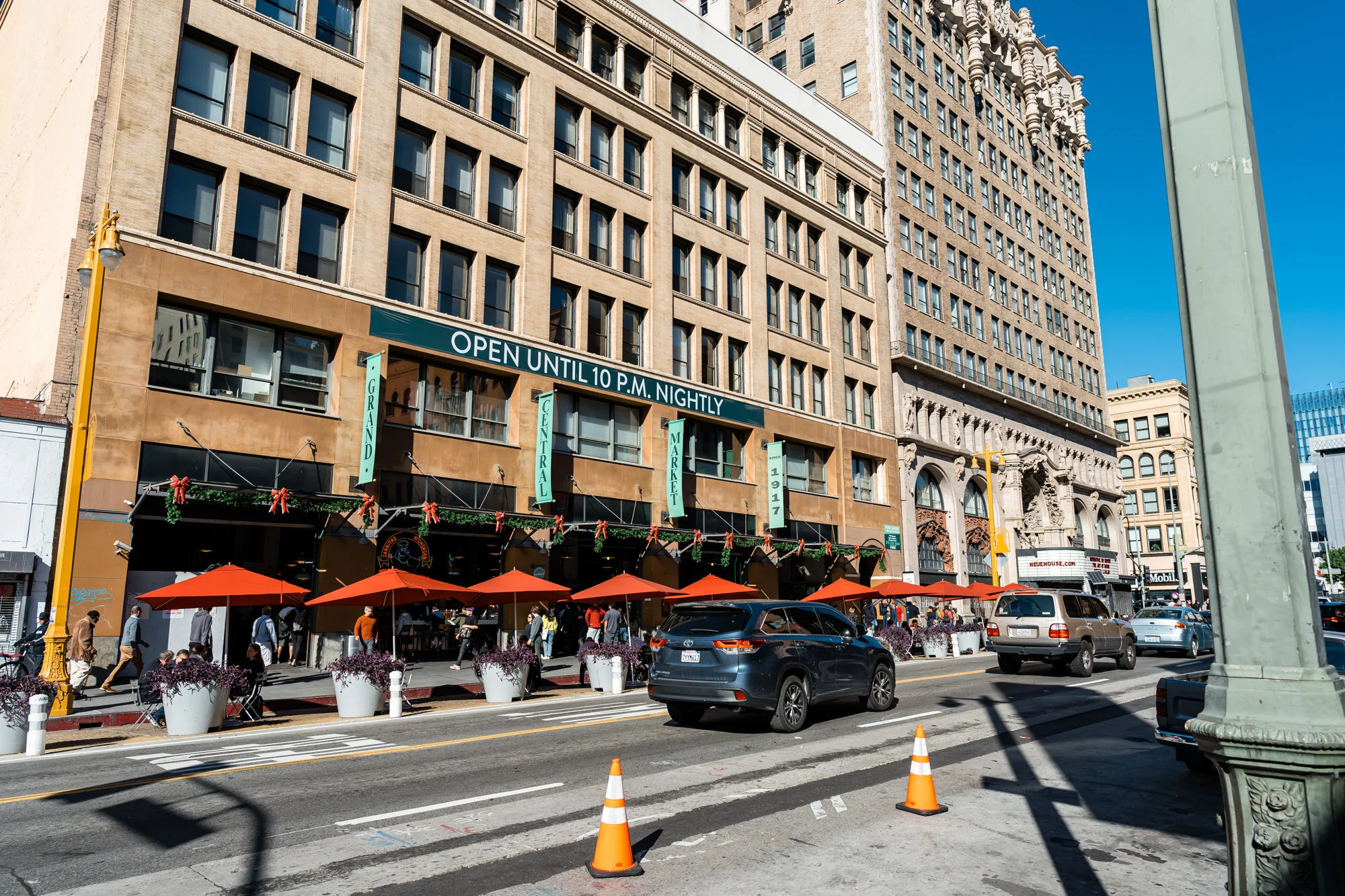
Grand Central Market can be a useful food and orientation anchor for residents near the Historic Core, while Little Tokyo, South Park, the Arts District, and the Fashion District each offer different combinations of food, services, and transit access. Your best anchor is the one you will actually repeat, not necessarily the one with the longest recommendation list.
## Make walking your connector
Walking fills the gaps between Metro stations and daily life. During the first week, create two short loops: one for morning and one for an evening errand. Keep each loop under thirty minutes at first. Include a coffee stop, a park or public space, a meal option, or a useful storefront so the route has a purpose.
Pay attention to block-by-block changes. DTLA is not one uniform neighborhood. A route through South Park will feel different from a route through the Historic Core or Little Tokyo, and the Arts District has its own mix of lofts, restaurants, studios, and working streets. The more specific your routes become, the more confidently you can choose where to live, meet people, and spend time.
## Plan the return trip
New residents often plan the trip out and improvise the trip home. Reverse that habit. Before leaving, identify the station entrance, corner, or landmark you will use for the return. If you are carrying groceries, meeting friends, or staying out after dinner, decide whether you will walk, ride Metro, or use a short rideshare segment.
This is especially helpful when you are learning a new neighborhood. A clear return plan keeps a good outing from turning into an exhausting search for the right entrance or pickup point. It also helps you compare buildings: the best apartment is not only close to destinations, but easy to reach again when you are tired and carrying something.
## Use rideshare strategically
Living without a car does not mean every trip has to be a strict walk-or-Metro decision. Use rideshare for the gaps that would otherwise make the whole routine feel difficult: a late-night return, a large purchase, an unfamiliar appointment, or a trip with luggage. Keep the service as a backup layer instead of making it your default for every short distance.
When you request a ride, choose a clear pickup point rather than dropping a pin at a complicated building entrance. A wide corner, hotel entrance, or known storefront can save time and reduce confusion. After a few trips, you will learn which parts of your block work best for pickups and deliveries.
## A practical first-week schedule
On day one, walk your home-to-station route and identify one coffee or breakfast stop. On day two, make a short Metro ride and return using the same station system. On day three, complete one small household errand on foot. On day four, try the route during the time you are most likely to use it. On the weekend, combine Metro with a neighborhood loop through a part of DTLA you have not yet explored.
The schedule is intentionally ordinary. The first week is about reducing daily friction, not collecting every downtown recommendation. By the end, you should know how to leave home, buy something basic, reach another neighborhood, and get back without opening a new plan every time.
## Bottom line
A car-free DTLA life works best when your routes are specific. Learn one station path, one walking loop, one errand anchor, and one dependable return plan. Then add neighborhoods one at a time: the Historic Core for architecture and central connections, Little Tokyo for food and daily texture, South Park for major destinations and newer residential blocks, and the Arts District for creative energy and loft-oriented walking.
Downtown becomes easier when your map is built from habits instead of highlights. Give yourself a week to test the routes, notice the friction, and keep the ones you would genuinely repeat.